
Asset lifecycle management is the end-to-end discipline of governing physical and IT assets from initial planning through final disposal to maximize value, control costs, and maintain compliance. The industry recognizes five standard stages in this process: planning and procurement, deployment, maintenance and monitoring, optimization, and retirement. Advanced IT governance models extend this to 11 sub-stages to close visibility gaps that passive discovery tools routinely miss. For IT professionals and asset managers across Indian enterprises, mastering this discipline in 2026 means the difference between controlled operational costs and avoidable budget overruns. Itcontrolbox supports this discipline with automation built for the full asset lifecycle.
What are the key stages of the asset lifecycle?
Asset lifecycle management follows a defined sequence. Each stage has a distinct owner, a set of required data inputs, and clear deliverables. Skipping or under-governing any stage creates downstream problems that compound over time.
Planning and procurement
Planning sets the financial and technical baseline for every asset. This stage involves needs assessment, budget approval, vendor selection, and purchase order management. Poor planning at this stage leads to over-procurement, mismatched specifications, and wasted capital expenditure. Indian IT teams operating under tight procurement cycles often compress this stage, which creates reconciliation problems later.

Deployment
Deployment covers physical receipt, configuration, tagging, and assignment to an end user or system. Lifecycle analytics at this stage establish the asset's baseline configuration and link it to a user identity, a cost center, and a service record. Zero-touch deployment models, where devices arrive pre-configured and ready to assign, reduce deployment time and human error significantly.
Maintenance and monitoring
Active maintenance and real-time monitoring form the operational core of the lifecycle. This stage tracks performance metrics, schedules preventive maintenance, logs repair history, and flags warranty expirations. Without structured maintenance planning, organizations rely on reactive repairs, which cost more and cause unplanned downtime.
Optimization
Optimization uses accumulated performance and cost data to decide whether an asset should be upgraded, redeployed, or flagged for replacement. Data-driven end-of-life decisions require complete maintenance and performance history. Organizations that skip formal optimization cycles make replacement decisions based on anecdote rather than evidence, which inflates total cost of ownership.
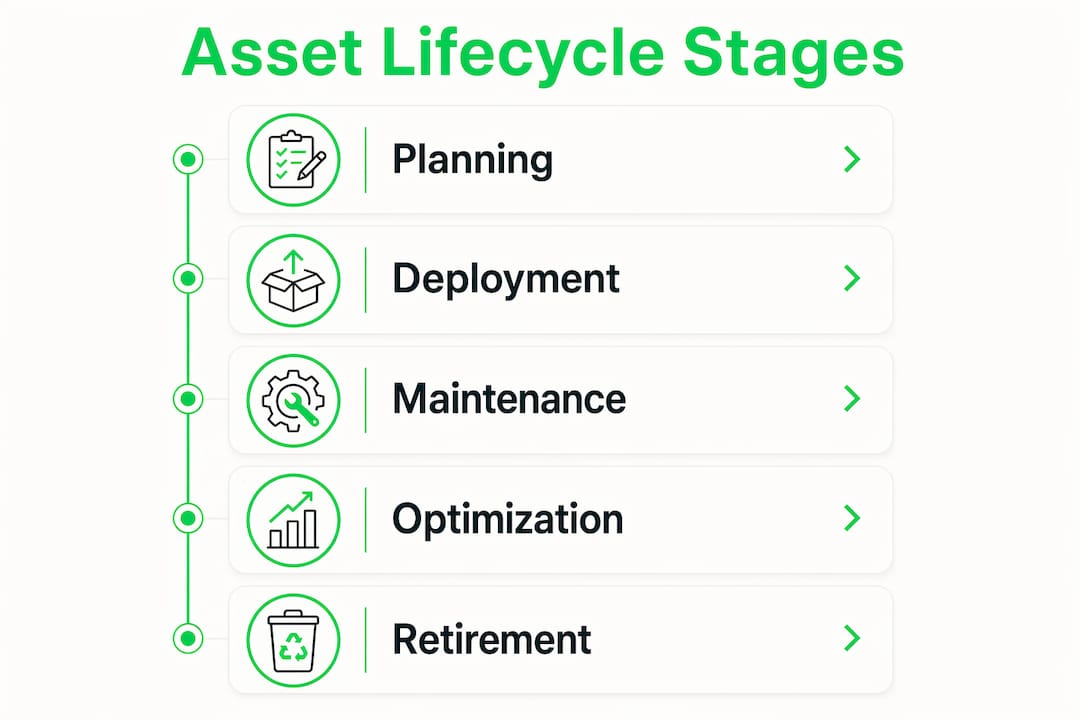
Retirement and disposal
Retirement closes the lifecycle with secure data sanitization, formal de-registration, and documented chain of custody. Hardware asset retirement options include resale, donation, recycling, or certified destruction. Each option carries regulatory and data security implications, particularly under India's Digital Personal Data Protection Act, 2023.
| Stage | Primary owner | Key deliverable |
|---|---|---|
| Planning and procurement | Finance, IT procurement | Approved asset register entry |
| Deployment | IT operations | Configured, tagged, and assigned asset |
| Maintenance and monitoring | IT support, facilities | Maintenance log, warranty record |
| Optimization | Asset manager | Refresh or redeployment recommendation |
| Retirement and disposal | IT security, compliance | Sanitization certificate, disposal record |
Pro Tip: Tag every asset with a unique identifier at the point of physical receipt, not after deployment. This single practice eliminates the most common source of asset register discrepancies.
Why is comprehensive lifecycle governance critical for IT teams?
Fragmented tracking is the root cause of most asset management failures. IT teams that track only active, enrolled devices create governance blind spots for assets that are staged, in transit, under repair, or awaiting disposal. Those blind spots cause direct financial and operational harm.
The consequences of partial lifecycle visibility are concrete and measurable:
- Asset loss: Devices that leave active enrollment fall off the radar. They accumulate in storage rooms, get reassigned informally, or disappear entirely.
- Compliance failures: Audit requests expose gaps when asset records do not match physical inventory or disposal certificates.
- Automation failures: Lifecycle automation depends on accurate state data. An asset recorded as "active" when it is actually decommissioned triggers incorrect workflows, license renewals, and security policies.
- Wasted expenditure: Procurement teams re-order assets that already exist in untracked inventory. This is a common and expensive problem in large Indian IT organizations managing thousands of endpoints.
- Security exposure: Devices without formal retirement records may retain sensitive data. This creates regulatory liability under both organizational policy and national data protection law.
Full lifecycle governance covering all 11 IT asset lifecycle stages eliminates these risks. It also creates the data foundation that automation systems require to function correctly.
Pro Tip: Run a quarterly reconciliation between your asset register and your network discovery tool output. The gap between those two lists is your governance risk exposure.
The benefits of complete lifecycle visibility extend beyond risk reduction. Audit readiness improves because every asset has a documented history from procurement to disposal. Capital planning becomes more accurate because replacement forecasts draw on real maintenance cost data rather than assumptions. IT support teams spend less time investigating asset status and more time resolving user issues.
What are the best practices for managing the asset lifecycle?
Effective asset management strategies share a common structure: integrated data, automated workflows, and clear ownership at every stage. The following practices reflect what mature organizations do differently from those still managing assets through spreadsheets and manual tickets.
-
Build a single source of truth. Automated reconciliation combined with manual tagging overcomes the gaps that automated discovery tools leave behind. Your asset register must combine data from procurement systems, network discovery, help desk records, and physical audits into one authoritative record. Any system that requires manual cross-referencing between four separate tools will fail at scale.
-
Automate lifecycle event triggers. Automated lifecycle workflows triggered by asset condition changes replace manual ticketing with event-driven processes. When a device reaches a defined age threshold, a maintenance cost ceiling, or a warranty expiration date, the system should automatically initiate the next lifecycle action without human intervention.
-
Connect capital planning to maintenance history. End-of-life decisions must draw on accumulated data covering maintenance costs, repair frequency, and total cost of ownership. Organizations that separate their capital planning function from their maintenance records make replacement decisions in the dark. Linking these two data sets produces accurate refresh forecasts and defensible budget requests.
-
Govern pre-deployment and post-deployment phases explicitly. Complete lifecycle governance must cover assets before they are deployed and after they leave active service. Devices sitting in a warehouse or awaiting sanitization are still organizational assets with financial and security implications. Passive network discovery tools never see these devices.
-
Assign clear ownership at every stage. Each lifecycle stage needs a named owner with defined accountability. When no one owns the optimization stage, assets stay in service past their economic life. When no one owns retirement, disposal records go missing and compliance audits become painful.
-
Use lifecycle analytics for refresh forecasting. Lifecycle analytics aid in forecasting refresh demand, repair costs, and compliance audit readiness. Organizations that build refresh models from real asset data reduce both emergency procurement and over-procurement.
Pro Tip: Do not wait for an audit to discover disposal gaps. Schedule a formal retirement review every six months and treat unresolved disposal records as open risk items.
How does IT asset lifecycle management fit within broader ALM?
IT asset lifecycle management, often called Hardware Asset Management (HAM) or IT Asset Management (ITAM), is a specialized subset of the broader ALM discipline. It applies the same five-stage framework but extends it to 11 granular stages that reflect the specific complexity of IT hardware environments.
The 11 stages in a mature ITAM model include: request, approval, procurement, receiving, staging, deployment, discovery, monitoring, refresh planning, decommissioning, and disposal. Each stage beyond the basic five addresses a specific gap that IT environments face. The staging phase, for example, covers the period between physical receipt and active deployment. Passive network discovery tools never detect staged devices. This creates an immediate gap in asset visibility that grows over time.
| ITAM stage | Risk if unmanaged |
|---|---|
| Staging | Devices lost before deployment; no asset record created |
| Discovery | Shadow IT assets operate outside governance |
| Refresh planning | Devices run past economic life; support costs spike |
| Decommissioning | Active licenses and security policies remain on retired devices |
| Disposal | Data sanitization skipped; regulatory liability created |
ITAM differs from Enterprise Asset Management (EAM) and Computerized Maintenance Management Systems (CMMS) in scope and focus. EAM covers physical infrastructure including facilities and industrial equipment. CMMS focuses on maintenance scheduling. ITAM addresses the full lifecycle of IT hardware and software assets, with particular emphasis on identity linkage, license compliance, and data security at retirement.
True ALM links daily maintenance activities to capital planning, preventing downtime and avoidable costs. In IT environments, this means connecting help desk repair records, warranty data, and refresh schedules into a single planning view. Itcontrolbox delivers this integration through automated identity and device lifecycle workflows that reduce manual effort by up to 70%, according to the platform's published specifications.
Pro Tip: Map your ITAM stages against your current toolset and identify which stages have no automated data capture. Those gaps are where your governance program is most exposed.
Key Takeaways
Effective asset lifecycle management requires full-stage governance, automated workflows, and data-driven decisions at every phase from procurement to disposal.
| Point | Details |
|---|---|
| Five core stages | Planning, deployment, maintenance, optimization, and retirement form the recognized ALM framework. |
| Full lifecycle visibility | Tracking only active assets creates blind spots that cause waste, compliance failures, and automation errors. |
| Single source of truth | Combining automated discovery with manual tagging produces the accurate asset records governance requires. |
| Automate lifecycle triggers | Event-driven workflows replace manual ticketing and improve audit readiness across all asset stages. |
| Link planning to maintenance data | Capital replacement decisions must draw on real maintenance cost and repair frequency data, not assumptions. |
Why most ALM programs stall at the same point
I have seen this pattern repeatedly across enterprise IT environments in India and elsewhere. Organizations invest in an asset management platform, complete a thorough initial audit, and build a clean asset register. Six months later, that register is already drifting from reality. New devices arrive and get deployed before anyone updates the record. Old devices get retired informally. The register becomes a historical document rather than a live governance tool.
The problem is almost never the technology. The problem is that organizations treat ALM as a project rather than a process. They implement a tool, declare success, and move on. No one owns the ongoing reconciliation. No one audits the disposal records. No one connects the maintenance cost data to the capital planning cycle.
The organizations that get this right share one characteristic: they treat asset data as a first-class operational input, not an administrative byproduct. Their procurement teams cannot close a purchase order without an asset record. Their IT support teams cannot close a ticket without updating the asset state. Their finance teams cannot approve a refresh budget without a maintenance cost report. The data flows because the process demands it.
The shift to automated lifecycle triggers changes this dynamic. When the system automatically updates asset state based on real events, the register stays current without depending on human discipline. That is the real value of automation in ALM. It removes the human failure point from data maintenance.
— Mahesh
How Itcontrolbox supports full asset lifecycle governance

Itcontrolbox delivers the automation layer that keeps asset records accurate across the full lifecycle. The platform connects procurement data, Active Directory identity records, and device management workflows into a unified asset view. When a device changes state, from staged to deployed, from active to decommissioned, Itcontrolbox triggers the corresponding identity and license actions automatically. This eliminates the manual reconciliation work that consumes IT team hours and introduces errors.
For Indian enterprises managing large endpoint fleets, Itcontrolbox reduces manual administrative effort by up to 70% while maintaining compliance audit trails at every lifecycle stage. Explore Itcontrolbox asset automation to see how the platform supports governance from procurement through secure disposal. For teams ready to evaluate a structured implementation, the Itcontrolbox solutions page outlines available options.
FAQ
What is asset lifecycle management?
Asset lifecycle management is the end-to-end process of governing physical and IT assets from planning and procurement through retirement and disposal. The goal is to maximize asset value, control costs, and maintain compliance across every stage.
How many stages does the IT asset lifecycle have?
The standard ALM framework covers five stages. Advanced IT asset management models extend this to 11 granular stages to address gaps in visibility that basic tracking misses, including staging, discovery, and formal decommissioning.
Why do asset registers become inaccurate over time?
Asset registers drift when organizations lack automated lifecycle triggers and clear stage ownership. Devices get deployed, repaired, or retired without updating the central record, creating gaps between the register and physical reality.
What is the difference between ITAM and EAM?
IT Asset Management (ITAM) focuses on IT hardware and software assets, including identity linkage, license compliance, and secure data disposal. Enterprise Asset Management (EAM) covers broader physical infrastructure such as facilities and industrial equipment.
How does hardware asset lifecycle management support compliance?
Hardware asset retirement requires documented data sanitization and formal de-registration to satisfy regulatory requirements. A complete lifecycle record from procurement to disposal provides the audit trail that compliance reviews demand.